|
|
|
What Is Hydraulic Fracturing?
Injection of Toxic Chemicals Into Underground Shale
Hydraulic fracturing (also known as fracking) is a technique used to create fractures that extend from the well bore into rock or coal formations. These fractures allow the oil or gas to travel more easily from the rock pores, where the oil or gas is trapped, to the production well. Typically, in order to create fractures a mixture of water, proppants (sand or ceramic beads) & chemicals is pumped into rock or coal formations. (text continues below).
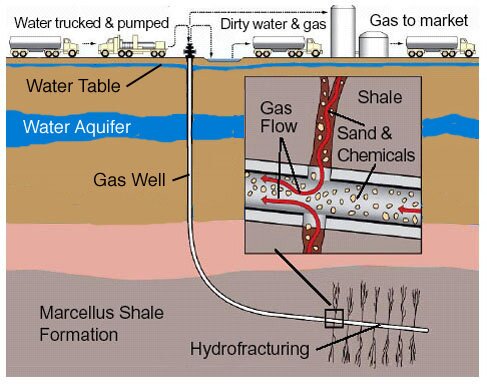
Eventually, the formation will not be able to absorb the fluid as quickly as it is being injected. At this point, the pressure created causes the formation to crack or fracture. The fractures are held open by the proppants, and the oil or gas is then able to flow through the fractures to the well.[3] Some of the fracturing fluids are pumped out of the well and into surface pits or tanks during the process of extracting oil, gas and any produced water, but studies have shown that anywhere from 20-40% of fracing fluids may remain underground.
Acidizing involves pumping acid (usually hydrochloric acid), into the formation. The acid dissolves some of the rock material so that the rock pores open and fluid flows more quickly into the well. Fracking and acidizing are sometimes performed simultaneously, in an acid fracture treatment.
Hydraulic Fracturing - Issues and Impacts
Hydraulic Fracturing Chemicals - Coalbed fracture treatments use anywhere from 50,000 to 350,000 gallons of various stimulation and fracturing fluids, and from 75,000 to 320,000 pounds of proppant during the hydraulic fracturing of a single well. Many fracturing fluids contain chemicals that can be toxic to humans and wildlife, and chemicals that are known to cause cancer. These include potentially toxic substances such as diesel fuel, which contains benzene, ethylbenzene, toluene, xylene, naphthalene and other chemicals; polycyclic aromatic hydrocarbons; methanol; formaldehyde; ethylene glycol; glycol ethers; hydrochloric acid; and sodium hydroxide Very small quantities of chemicals such as benzene, which causes cancer, are capable of contaminating millions of gallons of water.
Potential Groundwater Contamination
As mentioned previously, hydraulic fracturing is used in many coalbed methane (CBM) production areas. Some coal beds contain groundwater of high enough quality to be considered underground sources of drinking water (USDWs). According to the U.S. Environmental Protection Agency (EPA) ten out of eleven CBM basins in the U.S. are located, at least in part, within USDWs. Furthermore, EPA has determined that in some cases, hydraulic fracturing chemicals are injected directly into USDWs during the course of normal fracturing operations.[8] (Read stories by Peggy Hocutt and Laura Amos to learn how hydraulic fracturing of coalbeds and other geological formations has affected their lives.)
Frac Pit PHOTO
Calculations performed by EPA show that at least nine hydraulic fracturing chemicals may be injected into or close to USDWs at concentrations that pose a threat to human health. These chemicals may be injected at concentrations that are anywhere from 4 to almost 13,000 times the acceptable concentration in drinking water.
Not only does the injection of these chemicals pose a short-term threat to drinking water quality, it is quite possible that there could be long-term negative consequences for USDWs from these fracturing fluids. According to the EPA study, and studies conducted by the oil and gas industry, [10] between 20 and 40% of the fracturing fluids may remain in the formation, which means the fluids could continue to be a source of groundwater contamination for years to come.
The potential long-term consequences of dewatering and hydraulic fracturing on water resources have been summed up by professional hydrogeologist who spent 32 years with the U.S. Geological Survey:
At greatest risk of contamination are the coalbed aquifers currently used as sources of drinking water. For example, in the Powder River Basin (PRB) the coalbeds are the best aquifers. CBM production in the PRB will destroy most of these water wells; BLM predicts drawdowns...that will render the water wells in the coal unusable because the water levels will drop 600 to 800 feet. The CBM production in the PRB is predicted to be largely over by the year 2020. By the year 2060 water levels in the coalbeds are predicted to have recovered to within 95% of their current levels; the coalbeds will again become useful aquifers. However, contamination associated with hydrofracturing in the basin could threaten the usefulness of the aquifers for future use.
One potentially frustrating issue for surface owners is that it may not be easy to find out what chemicals are being used during the hydraulic fracturing operations in your neighborhood. According to the Natural Resources Defense Council, attempts by various environmental and ranching advocacy organizations to obtain chemical compositions of hydraulic fracturing fluids have not been successful because oil and gas companies refuse to reveal this "proprietary information."
As mentioned above, anywhere from 20-40% of fracing fluids remain in the ground. Some fracturing gels remain stranded in the formation, even when companies have tried to flush out the gels using water and strong acids. [13] Also, studies show that gelling agents in hydraulic fracturing fluids decrease the permeability of coals, which is the opposite of what hydraulic fracturing is supposed to do (i.e., increase the permeability of the coal formations). Other similar, unwanted side effects from water- and chemical-based fracturing include: solids plugging up the cracks; water retention in the formation; and chemical reactions between the formation minerals and stimulation fluids. All of these cause a reduction in the permeability in the geological formations.
Hydraulic Fracturing Chemical Disposal -
When companies have an excess of hydraulic fracturing fluids, they either use them at another job or dispose of them. Some company Material Safety Data Sheets include information on disposal options for fracturing fluids and additives. The table below summarizes the disposal considerations that the company Schlumberger Technology Corp. ("Schlumberger") includes in its MSDSs.
As seen in the table, Schlumberger recommends that many fracturing fluid chemicals be disposed of at hazardous waste facilities. Yet these same fluids (in diluted form) are allowed to be injected directly into or adjacent to USDWs. Under the Safe Drinking Water Act, hazardous wastes may not be injected into USDWs.[16] Moreover, even if hazardous wastes are diluted with water so that the hazardous characteristics of the fluids are removed, the wastes still cannot be injected into USDWs. If unused hydraulic fracturing fluids are indeed "hazardous wastes", it is unconscionable that EPA is allowing these substances to be injected directly into underground sources of drinking water.
Hydraulic Fracturing Best Practices-
From a public health perspective, if hydraulic fracturing stimulation takes place, the best option is to fracture formations using sand and water without any additives, or sand and water with non-toxic additives. Non-toxic additives are being used by the offshore oil and gas industry, which has had to develop fracturing fluids that are non-toxic to marine organisms.
It is common to use diesel in hydraulic fracturing fluids. This should be avoided, since diesel contains the carcinogen benzene, as well as other harmful chemicals such as naphthalene, toluene, ethylbenzene and xylene. According to the company Halliburton, "Diesel does not enhance the efficiency of the fracturing fluid; it is merely a component of the delivery system." [18] It is technologically feasible to replace diesel with non-toxic "delivery systems," such as plain water. According to the EPA, "Water-based alternatives exist and from an environmental perspective, these water-based products are preferable."
Mud Reserve Pit PHOTO
Torn pit liners can lead to groundwater contamination-
Oil and gas wastes are often flowed back to and stored in pits on the surface. Often these pits are unlined. But even if they are lined, the liners can tear and contaminate soil and possibly groundwater with toxic chemicals. (Read more about pits.) As mentioned above, toxic chemicals are used during hydraulic fracturing operations. The same chemicals that are injected come back to the surface in the flowed-back wastes. As well, hydrocarbons from the fractured formation may flow back into the waste pits. A preferable way of storing wastes would be to flow them back into steel tanks.
ENERGY POLICY ACT OF 2005- key paragraphs:
SEC. 322. HYDRAULIC FRACTURING.
Paragraph (1) of section 1421(d) of the Safe Drinking Water Act (42 U.S.C. 300h(d)) is amended to read as follows:
(1) UNDERGROUND INJECTION.The term underground injection
(A) means the subsurface emplacement of fluids by well injection; and
(B) excludes
(i) the underground injection of natural gas for purposes of storage; and
(ii) the underground injection of fluids or propping agents (other than diesel fuels) pursuant to hydraulic fracturing operations related to oil, gas, or geothermal production activities..
SEC. 323. OIL AND GAS EXPLORATION AND PRODUCTION DEFINED.
Section 502 of the Federal Water Pollution Control Act (33 U.S.C. 1362) is amended by adding at the end the following:
(24) OIL AND GAS EXPLORATION AND PRODUCTION.The term oil and gas exploration, production, processing, or treatment operations or transmission facilities means all field activities or operations associated with exploration, production, processing, or treatment operations, or transmission facilities, including activities necessary to prepare a site for drilling and for the movement and placement of drilling equipment, whether or not such field activities or operations may be considered to be construction activities..
|
|


Federal-State Source Documents






Gas Drilling
Awareness Coalition
General Meeting
Tuesday September 20th
at 7 pm
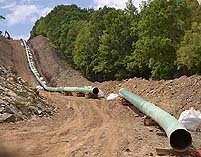
Topic: the Atlantic Sunrise & PennEast Pipelines threatening EMINENT DOMAIN.
Dallas American Legion
730 Memorial Hwy
Dallas, PA 18612
------------------------------------------------
|